
Running a Sex Offender Check in Orange County
The Texas Public Sex Offender Registry is the primary official search for Orange County. DPS maintains the public data, while local police departments and the Sheriff's Office perform registration and verification duties. Search by name when checking a known person. Use the address-map mode for local awareness, and use the higher-education mode when that setting is relevant.
Exact map-radius choices could not be verified in the live interface, so do not assume a fixed distance. Compare name, aliases, physical description, address or geographic description, registration agency, offense, and status before drawing a conclusion. A shared name alone is not enough.
Orange County Registration Authority
Where a person lives determines the local registration office. A resident inside a city reports to that city's police chief or local authority. A resident of unincorporated Orange County reports to the Sheriff's Office. Contact the relevant office for its current appointment process, location, proof requirements, and any fee because no dependable local registration fee was identified.
Initial and update deadlines are generally tied to seven days. Before moving, a registrant reports the intended move in person by the seventh day before departure. After arrival in another Texas jurisdiction, the person reports by the seventh day with identification and proof required by that authority. These are registration duties, not search instructions for the public.
Verification frequency also depends on category. Most registrants verify annually. A person with two or more sexually violent offenses generally verifies every 90 days, while a civilly committed sexually violent predator verifies every 30 days. The public should rely on the listed agency and current profile rather than guessing a schedule from an offense label.
Orange County Sheriff's Office
Unincorporated-county registration authority
205 S. Border St.
Orange, TX 77630
409-883-2612
Searching the Texas Public Sex Offender Registry
Texas DPS provides the registry at no charge. Its three identified modes support a registrant-name query, an address-based map view, and an institute-of-higher-education search. The DPS mobile app also advertises location, name, route, and proximity-based registry tools.
- Open the Texas DPS registry and review its current conditions and notices.
- Select Registrant Name, Map Address, or Institute of Higher Education.
- Enter only the fields needed for that mode, then submit the search.
- Compare the returned identifiers and registration agency before opening a profile.
- Read the offense, address, status, supervision, and verification context together.
| Field Label | Type | Required | Notes |
|---|---|---|---|
| Registrant Name | Mode and text | Mode-specific | Use profile identifiers to distinguish similar names |
| Map Address | Mode and address | Mode-specific | Exact radius choices were not verified in the live interface |
| Institute of Higher Education | Mode and selection | Mode-specific | Finds registrants tied to an institution |
| Location, route, proximity | DPS app controls | No | Advertised mobile-app search features |
| Search, Clear, Map, List | Controls | No | Confirm exact live labels when using the portal |
The official Texas registry search shows the current public interface.
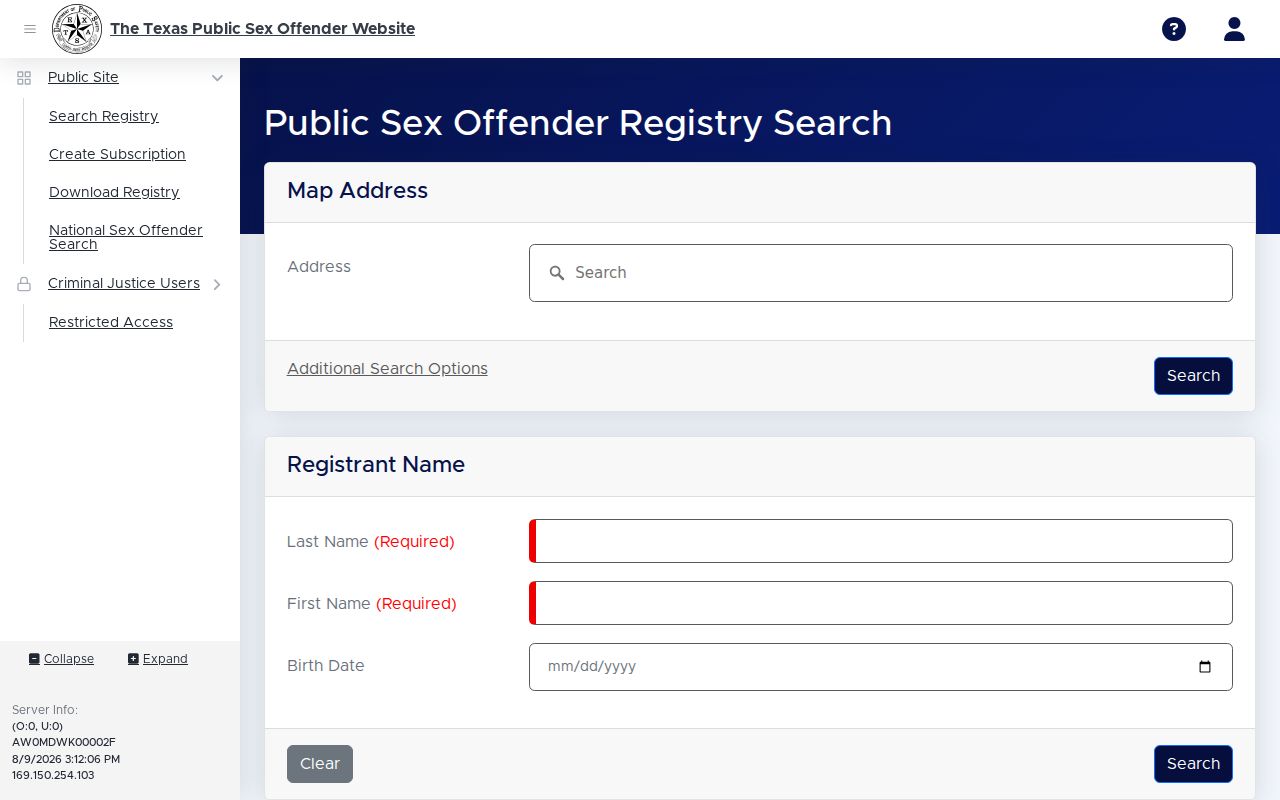
The current form, rather than a copied list, is the best place to confirm a profile's latest published status.
Mobile access adds a distinct official channel. The Texas DPS app advertises searches based on location, name, route, and proximity. Those features may help during travel within Orange County, but the same matching rules apply. A map marker or proximity result should be opened and compared against the full profile before it informs a safety plan.
Orange County Cross-State Registry Search
Orange County sits on the Louisiana border. A Texas-only search can miss a relevant record from another jurisdiction. The U.S. Department of Justice's NSOPW search spans participating state, tribal, and territorial registries and routes the user back to the jurisdiction that supplies each record.
The National Sex Offender Public Website is the official cross-state layer.
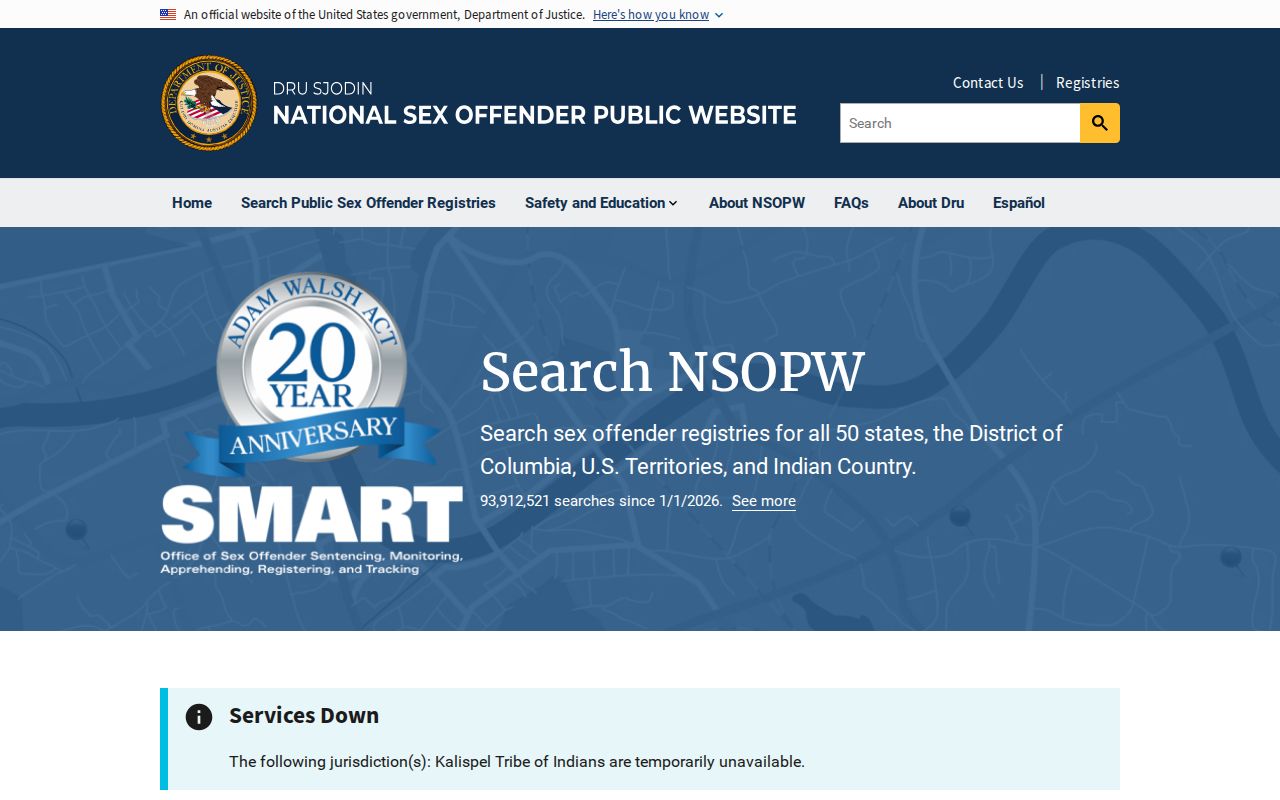
Use NSOPW to widen geography, then verify the details and status with the originating registry or listed registration agency.
What a Registry Profile Shows
A public profile can combine identity, location, offense, and supervision information. Article 62.005 also excludes sensitive fields from the public site. Those limits protect data such as Social Security and driver-license numbers, phone numbers, online identifiers, employer details, victim-identifying information, and other data DPS designates as nonpublic. A juvenile court may order juvenile registration kept from public view.
| Name and Aliases | Published identity names used to distinguish the registrant. |
|---|---|
| Photo and Description | Recent color photo plus sex, race, height, weight, hair, eyes, and shoe size when published. |
| Registered Address | Home address or a geographic description, subject to statutory treatment. |
| Reportable Offense | Offense, victim age, conviction date, punishment, and related case facts available by law. |
| Supervision and Status | Release or supervision information, registration agency, and status when shown. |
| Other Public Fields | Higher-education link, licenses or permits, and qualifying trafficking-offense vehicle data. |
Orange County Registry Data Boundaries
Public does not mean unlimited. DPS publishes fields that Chapter 62 makes public while withholding specific identifiers and victim-related data. A profile can therefore be detailed without exposing every item held by law enforcement. Absence of a phone number, online identifier, employer, or driver-license number is an intentional legal boundary, not a missing search result.
Registry information also differs from an arrest roster or current offense report. The listed reportable offense explains the duty to register. It does not show that a new offense occurred. For current safety concerns or suspected violations, use the registration agency shown on the profile rather than drawing an inference from the listing alone.
Some published vehicle information is limited to qualifying trafficking offenses. Higher-education information also appears only when the statutory facts support it. A blank field may therefore reflect the law's scope rather than a data error. For a suspected stale address or missed verification, report the exact concern to the local authority instead of trying to fill the gap independently.
Note: Match several published identifiers before treating two similar Orange County registry names as the same person.
Registration Requirements and Levels in Texas
Texas does not use federal Tier I, II, and III labels as its public duration system. Duration turns on the reportable offense, adult or juvenile status, release or discharge event, repeat-offense rules, and other statutory facts. Most verification is annual, while people with two or more sexually violent offenses generally verify every 90 days and civilly committed sexually violent predators every 30 days.
| Level / Tier | Duration | Verification Frequency |
|---|---|---|
| Specified adult lifetime category | Life | Usually annual unless enhanced |
| Other adult reportable case | Until the 10th anniversary after the latest statutory release or discharge event | Annual |
| Juvenile adjudication | Until the 10th anniversary after the later of disposition or completion | Annual |
| Transferred juvenile tried as adult | Statutory ten-year calculation | Annual |
| Extrajurisdictional registrant | Until originating duty expires | Texas or statutory basis |
| Civilly committed sexually violent predator | Underlying duration, often life | Every 30 days |
| Two or more sexually violent offenses | Underlying duration, generally life | Every 90 days |
Orange County Residency Rule Limits
Texas Chapter 62 does not impose one universal statewide residence-distance rule. Individual supervision conditions may limit where a person lives. State law also authorizes some municipal child-safety-zone ordinances. Those distinct sources should not be collapsed into a blanket claim that every Orange County registrant must live a fixed number of feet from schools, parks, or child-care sites.
Check the profile and contact the listed registration agency when a location raises a compliance question. The agency can determine which registration or supervision rule applies to that person. Registry map distance alone cannot answer that legal question.
Orange County Community Registry Notices
Texas community notification can extend beyond the online registry. For civilly committed or high-risk registrants, DPS may send English and Spanish postcards to addresses within one mile in an unsubdivided area or within three blocks in a subdivided area. Qualifying school and newspaper notices also follow Article 62.
These notice zones describe the reach of a notice, not a statewide ban on residence within the same distance. Keep the concepts separate. Online registry searches support ongoing awareness, while mailed notices serve the groups and areas defined by law.
Neighborhood awareness works best with current official data and ordinary safety steps. Save the profile's registration-agency name and note the date checked. If a record later changes, the live registry should control. Do not repost a profile with claims that go beyond the offense, duty, and status DPS actually publishes.
Note: DPS Sex Offender Registration staff can be reached at 512-424-2800 for state-program questions.
Lawful Use and Community Notification
Registry information supports public awareness and practical safety planning. It is not proof of present misconduct. Do not use a result to harass, threaten, trespass, target a household, or discriminate unlawfully. Report suspected failure to register to the agency named on the profile, which can check the underlying record and current duty.
Use registry data lawfully: Texas Code of Criminal Procedure Chapter 62 governs registration and public information. DPS materials identify no standalone registry-misuse penalty, but general criminal and civil laws still apply to threats, harassment, trespass, vigilantism, and unlawful discrimination. Article 62.102 separately makes defined failures to comply with registration duties a felony.
Report Orange County Registry Concerns
Begin with the profile's listed registration agency. City police handle registrants who reside inside that city, while OCSO handles unincorporated Orange County. Give the agency the profile details and the specific conduct or address concern. Avoid confrontation and do not conduct a private compliance investigation.
A missing result does not establish that no duty exists. A juvenile registration can be nonpublic, records can change, and an out-of-state record may live in another jurisdiction. Use NSOPW when geography crosses state lines, then contact the originating agency shown in the official result.