
How to Check Criminal History in Orange
No single office holds every Orange criminal record. The right first stop depends on the event. Orange Police Department owns its incident and arrest reports. Orange Municipal Court keeps city ordinance, traffic, and fine-only misdemeanor cases. The Orange County Corrections Facility records a person who is taken into county custody. The County Clerk or District Clerk then holds a filed Class A or B misdemeanor or felony case. A Texas DPS record is a later statewide compilation, not a substitute for the city source.
- Ask Orange Police Records for the incident or arrest report and provide the event number, names, date, location, and requested format when known.
- Use the city's public-information form when the report is not offered as a routine counter copy or needs formal review.
- Search Orange Municipal Court for a citation, docket, police case, or city warrant tied to a Class C or ordinance matter.
- Check the Orange County jail and the correct county clerk if the event led to custody or a higher-level filed charge.
- Use the Texas DPS public name search for reported Texas convictions and deferred adjudications, or FAST fingerprinting to review your own identity-based Texas record.
The order matters. A recent Orange arrest may appear at the jail before a prosecutor files a case. A police report can exist without a municipal docket. Conversely, the city court may hold a citation that never produced a county booking. Search the record closest to the event, then follow the case only as far as its actual path requires.
Requesting Orange Police Records
The official Orange Police resources page routes requests for reports and fees and identifies the city's related public-safety resources. Orange Police Department is at 201 Eighth Street, Orange, TX 77630. The main number is 409-883-1026, while the Records Division has a direct line at 409-883-1091. A useful request names the report type and gives the event number, involved names, date and time, location, requester contact details, desired format, and any relationship or identification needed for protected material.
The official police resources screen provides a clear view of where an Orange resident begins:

That city source helps locate the correct request channel, but it does not replace the report itself or a later court disposition.
Published city fees include $4 for an accident, crime, or arrest report, plus $0.20 for extra pages. A certified report is $6. Open-record letter pages are listed at $0.10, with 11-by-17 pages at $0.50. The city lists $1 for a CD, $3 for a DVD, and $5 for photos placed on city media. Fingerprints are $10 plus $5 for added cards. The department will not place material on media supplied by the requester. Recheck charges before ordering because schedules can change.
The Orange Police Department
Orange Police Department creates the first city record for calls its officers handle. Its file can include the event number, date, location, alleged offense, officer actions, probable-cause facts, witnesses, evidence, and arrest details. Release is not automatic for every field. An open investigation, juvenile information, protected victim details, living-person birth dates, driver's-license data, and other confidential material may be withheld or redacted under Texas law.
Custody does not transfer ownership of the police narrative. If Orange officers take someone to the Orange County Corrections Facility, the sheriff creates a new booking record. The original Orange report remains with the city. Ask the police records staff for the narrative and the county jail for booking and bond facts. If charges are filed, ask the proper clerk for the case result.
Orange also offers an online public-information form through the City Secretary. The form calls for a specific description, the requester's contact block, phone and email, an electronic-signature agreement, and an electronic signature. An optional business block and email-copy choice are also present. Precise facts allow staff to route a police request without guessing which incident is meant.
Searching Orange Municipal Records
Orange is unusual among the county's three largest cities because it provides a dedicated municipal search route. The city links to MunicipalRecordSearch as its official court portal. The search is free, although payment processing can carry separate charges. Users may search by name, citation number, docket number, police case number, or warrant number. The police-case option is especially useful when a city report has already supplied that identifier.
| Search mode | Input | Best use |
|---|---|---|
| Name | Last name | Finding a city case when no number is known |
| Citation | Citation number | Locating the case created from a ticket |
| Docket | Docket number | Returning to a known municipal file |
| PD Case | Police case number | Connecting an Orange police event to court |
| Warrant | Warrant number | Checking the related city court matter |
A portal result should be read as a municipal court record, not a full Orange criminal history. It will not supply a felony file from a district court or the complete police narrative. Confirm the identity and current disposition with the court before relying on a same-name result.
Arrests and Bookings in Orange
Orange does not run a separate city jail roster. Orange Police Department transports custodial arrests to the Orange County Corrections Facility at 205 South Border Street. The sheriff's live roster can show a sheriff's office number, displayed name, birth date, age, race, gender, offense ID, arrest date, and book memo. Its detail view can add the offense description, warrant number, court, fine, and bond information. Those fields show custody and allegations, not guilt.
A missing roster entry does not prove there was no Orange arrest. The person may have been cited without jail, released, transferred, listed under another spelling, or held by another authority. Call the facility at 409-883-2612 when a recent booking cannot be found, then return to Orange Police Records for the incident report. For a deeper county-level explanation, the Orange County arrest history page separates the roster, agency report, and later court file.
Orange Police publishes yearly totals, not a public list of named arrestees. Its 2025 UCR report counted 393 index offenses and 61 clearances, including eight clearances involving people under 18. Those figures describe reported crime categories and clearance counts. They are not a booking log. DPS data can also change as agencies correct and update their monthly submissions.
Orange Court Records and Warrants
Orange Municipal Court is at 901 Main Street and can be reached at 409-883-1063. Its published hours are Monday through Friday, 8:00 a.m. to 5:00 p.m. Sessions run Monday through Wednesday. Sign-in begins at 8:00 a.m.; the session starts and the doors lock at 8:30 a.m. These session rules affect an in-person appearance, but they do not expand the court's jurisdiction.
The court offers cash, money order, local check, and card payments. The city says some outstanding-warrant cases can be paid online and lists MVBA at 866-955-5455. Payment is not a universal answer for every warrant or desired case outcome. First identify the court, charge, and case status. A county felony or Class A or B misdemeanor warrant will not become an Orange Municipal Court matter merely because the person lives in the city.
Municipal and county custodians can describe different parts of the same event. The city court can confirm a fine-only case or warrant. The police department owns the narrative. The jail may show a booking after execution. If the matter was filed at a higher level, a certified outcome must come from the county or district clerk.
Orange Municipal Court Records
Orange Municipal Court hears city ordinance violations, traffic matters, and fine-only Class C misdemeanors. It does not hold Orange County felony files or Class A and B misdemeanor proceedings. The portal can expose a case, docket, payment option, and office information, while the clerk remains the best source for the current status and an official copy.
| Court Name | City of Orange Municipal Court |
|---|---|
| Case Types Heard | Traffic, ordinance, and fine-only Class C matters within city jurisdiction |
| Case Lookup Channel | Official MunicipalRecordSearch portal, court clerk by phone, or the counter at 901 Main Street |
| What the Docket Shows | Case and docket identifiers, city case activity, upcoming settings, warrants where available, and payment actions |
| Copies & Fees | Confirm the requested record and current copy charge with the municipal court; processor fees may apply to online payments |
A city case can refer to a police incident without containing the entire report. Search by the strongest known identifier, then request the exact document from the office that created it.
Orange Police Record History
Official city history helps explain why Orange records can refer to older offices or buildings. Orange had a city marshal before its 1924 charter. The police department moved into a remodeled former savings-and-loan building at 805 Main Street in 1976. The city later awarded a purpose-built police and court project in 1999. Current police records are routed through the department at Eighth Street, while the court publishes its Main Street address.
The Orange Police Department history page preserves images and milestones from that local record story:

The historical view can explain an old address on a report, but current requests should use the modern department and court contacts.
Orange itself took its name after earlier names including Green's Bluff or Huntley, Lower Town of Jefferson, and Madison. Ship-channel work and wartime shipyards changed the city's scale. These shifts produced records under different civic structures. For genealogy or historical research, a modern portal may therefore be only the first check, not proof that an older file never existed.
Where Orange Records End Up
An Orange event can create several records at different times. Police write the incident or arrest report. A county booking adds custody and bond facts. The prosecutor then accepts, changes, or rejects charges. The County Clerk holds a filed Class A or B misdemeanor. The District Clerk holds a felony in the 128th, 163rd, or 260th District Court. Courts and custodial agencies later report qualifying data into Texas DPS systems.
Record flow: Orange Police Department › Orange County Courts › Texas Department of Public Safety
This flow explains common mismatches. A booking charge can differ from the filed charge. A municipal citation may never enter county court. A DPS public result covers reported Texas convictions and deferred adjudications made public by law, while a fingerprint personal review is the stronger way to check your own identity-based state record.
Orange Charge Level Record Map
A charge label tells an Orange searcher which court should hold the filed case. Fine-only Class C and city ordinance matters stay in Orange Municipal Court. Class A and B misdemeanors are filed with the Orange County Clerk. Felonies proceed through the District Clerk in one of the county's three district courts. The arresting officer's first charge can still change after prosecutor review.
- Complaint
- A sworn allegation that can start or support a criminal matter.
- Information
- A prosecutor-filed charging instrument often used for misdemeanors.
- Indictment
- A felony charging instrument returned by a grand jury.
- Disposition
- The outcome or status that resolves a charge in court.
Use the clerk's disposition rather than the booking charge when the goal is to understand the court result.
When Orange Record Portals Stop
A blank screen or missing name is not a final answer. Orange County's online records page warns that its linked system requires a desktop computer and may fail on phones, tablets, firewalls, or browsers without suitable document support. Public computers and index books remain available through the clerks. re:SearchTX can locate e-filed court material, but its coverage and public document access vary by court.
Orange's city portal has its own boundary. It covers municipal matters, not the full county record. The city public-information form is better for an unavailable police report. Its required fields include a specific description, name, mailing address, phone, email, electronic-signature agreement, and signature. The following official form image shows that separate request route:
View the City of Orange public-records request source.
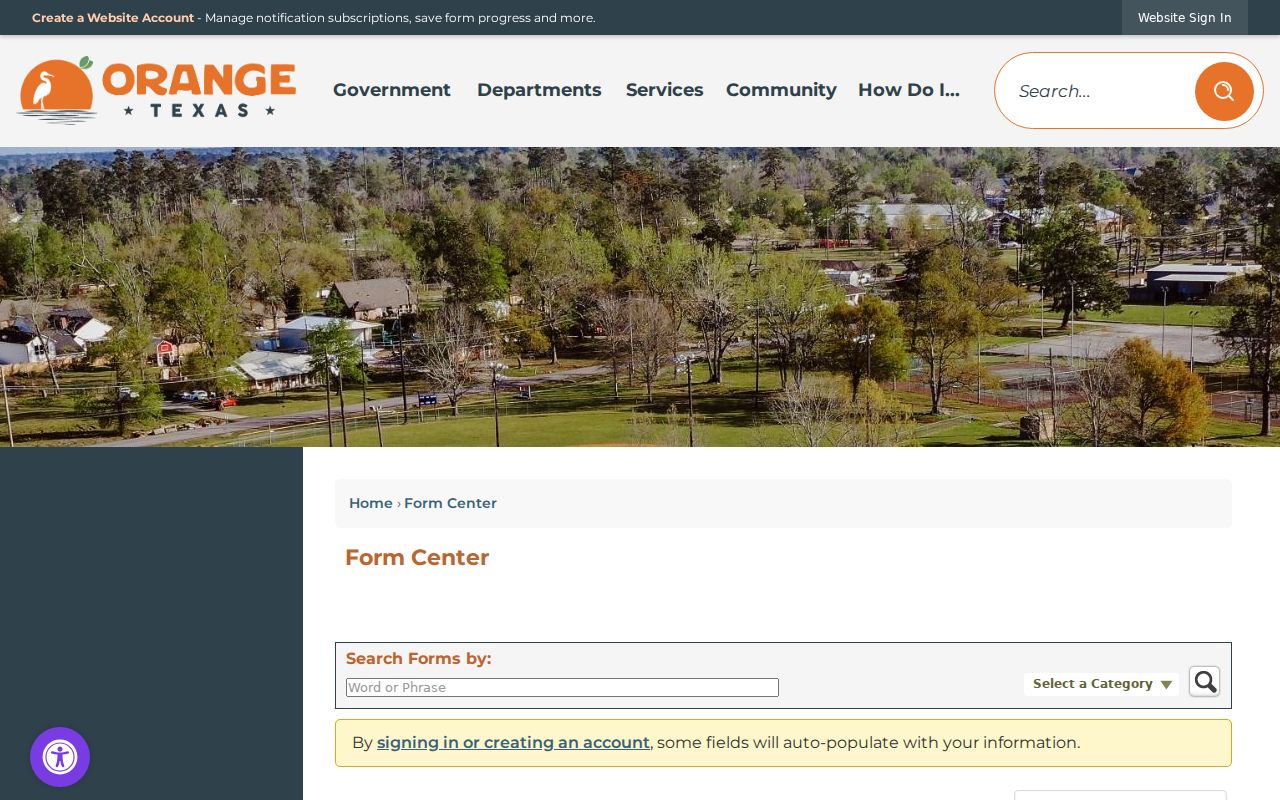
The form routes a city request for review; it does not make the city clerk the custodian of county jail or district court files.
Public Access Rules
The Texas Public Information Act generally directs a person to the office that created the requested government record. Orange Police Department handles its reports, and Orange Municipal Court handles its own case files. The law does not require either city office to fetch a county clerk file or answer a legal question. Some information can be withheld when release would interfere with an investigation or when another law makes it confidential.
Key Statutes:
Texas Government Code Chapter 552 gives the public access to government information, subject to stated exceptions and required redactions.
Texas Government Code Section 411.083 makes DPS criminal history record information confidential except where Chapter 411 authorizes access.
Texas Government Code Section 411.135 makes specified conviction and deferred-adjudication history available through the DPS public product.
Juvenile information, protected victim identities, sealed or expunged material, and sensitive personal identifiers can stay out of a public copy. An absent Orange record may also be archived, delayed, or held by another custodian. Confirm the office and record type before treating a portal miss as a clean history.