
Criminal Cases in the Orange County Courts
Orange County felony records belong to the District Clerk. That office serves the 128th, 163rd, and 260th District Courts. It indexes pleadings, enters judgments, collects court costs and fines, issues warrants and capiases, and prepares criminal appeals for the Ninth Court of Appeals. The felony desk is the best source for a certified judgment or a case that does not appear online.
The County Clerk keeps Class A and Class B misdemeanor minutes for the county-level courts. Fine-only cases remain with a justice court or the municipal court that heard them. That split matters. A City of Orange citation will not become a district-court file merely because it arose in Orange County. Start with the charge level and filing court, not the arresting agency.
Clerk custody also differs from prosecution. The District and County Attorney decides what charge to pursue, but the clerk indexes what is filed and preserves the orders and judgment. The jail can confirm a recent booking while the prosecutor is still reviewing the incident. That early custody entry may use a different charge label from the later information or indictment.
Orange County Felony Court Routes
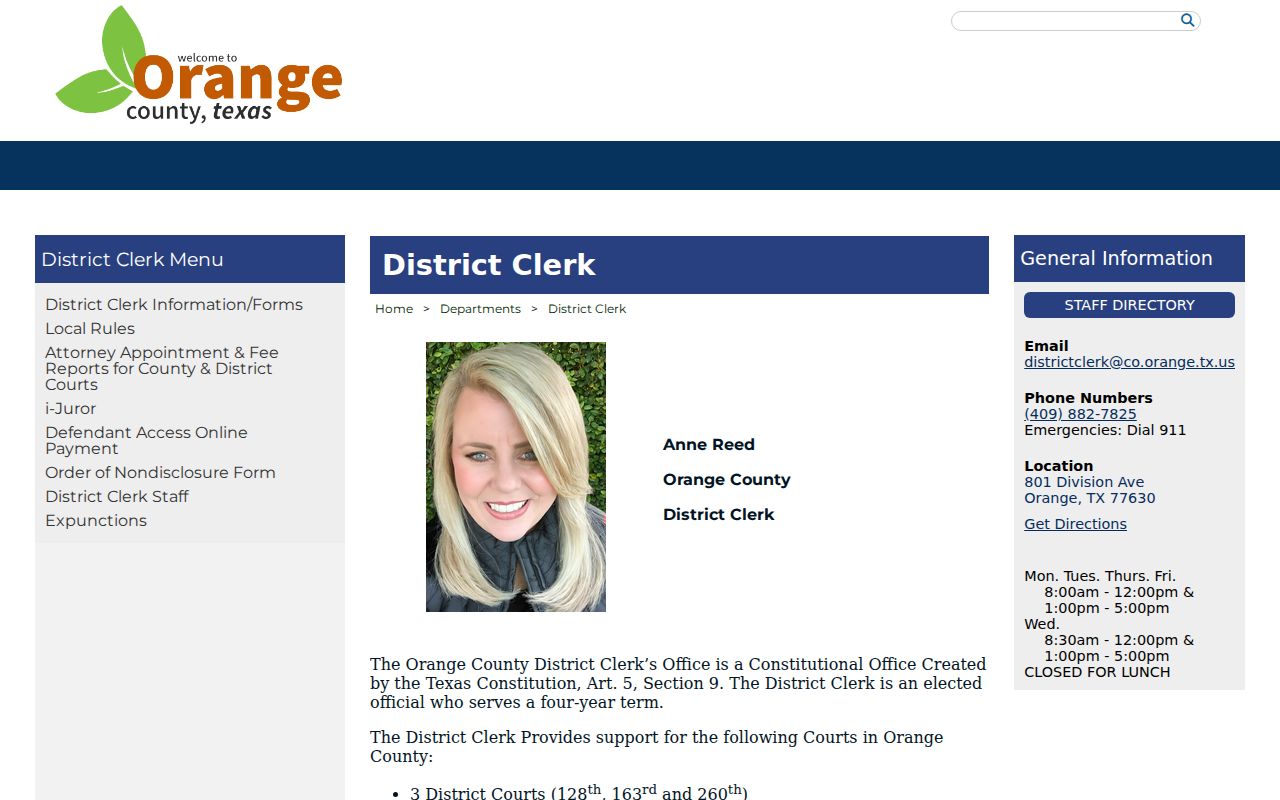
Three district courts share Orange County felony work, while the District Clerk provides the common records door. The official District Clerk page identifies the courts served and the office contact. Call the felony desk at 409-882-7817 when a filing is old, missing from re:SearchTX, or needed as a certified copy.
The District and County Attorney reviews charges and prosecutes county criminal cases. A booking allegation can be rejected, reduced, enhanced, or replaced before filing. The clerk file, rather than the initial jail entry, shows what the prosecutor actually placed before a court.
The official prosecutor page provides a useful view of the local charging office.
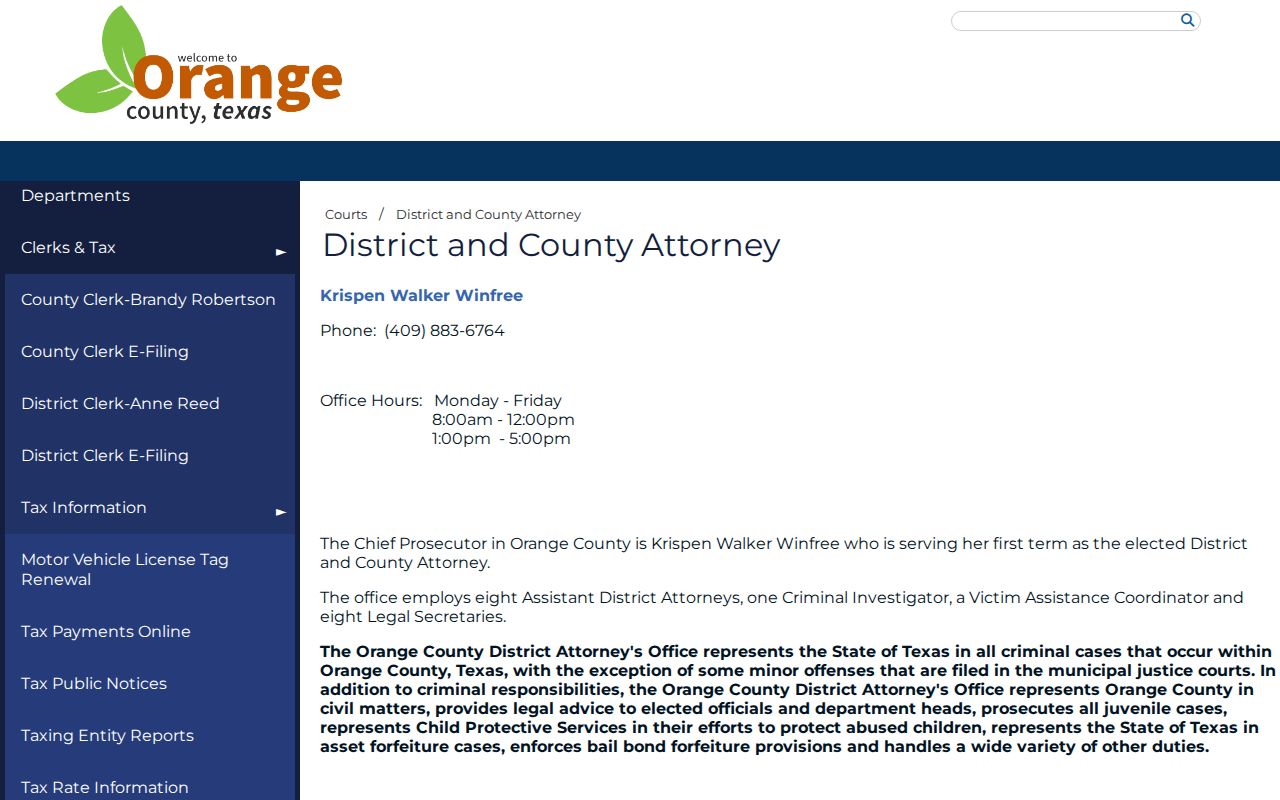
That separation between prosecution and record custody explains why requests for pleadings and judgments still go to the clerk.
How to Search Case Records
Use re:SearchTX for statewide e-filed material, then confirm important results with the Orange County clerk. Coverage and document access vary by court and public-account role. A case number is the strongest key. Party name, filing range, court, and case status can narrow a broader search.
- Open re:SearchTX and sign in under the available public role.
- Search by exact case number when known, or use the party-name option.
- Filter for Orange County, the likely court, status, case type, or filed-date range.
- Open the result and compare the case style, court, filing date, parties, and events.
- Ask the District Clerk or County Clerk for any missing document and for certified copies.
| Field Label | Type | Required | Notes |
|---|---|---|---|
| Search by | Tab or option | Yes | Case, person or party, organization, or filing, depending on role |
| Case number | Text | No | Best exact key |
| Party name | Text | No | Person or organization |
| Court and county | Filter | No | Select Orange County and the likely court |
| Case type or status | Filter | No | Availability depends on court data |
| Filed date range | Dates | No | Helps separate common names |
The re:SearchTX portal shows the actual search interface used for participating e-filed records.
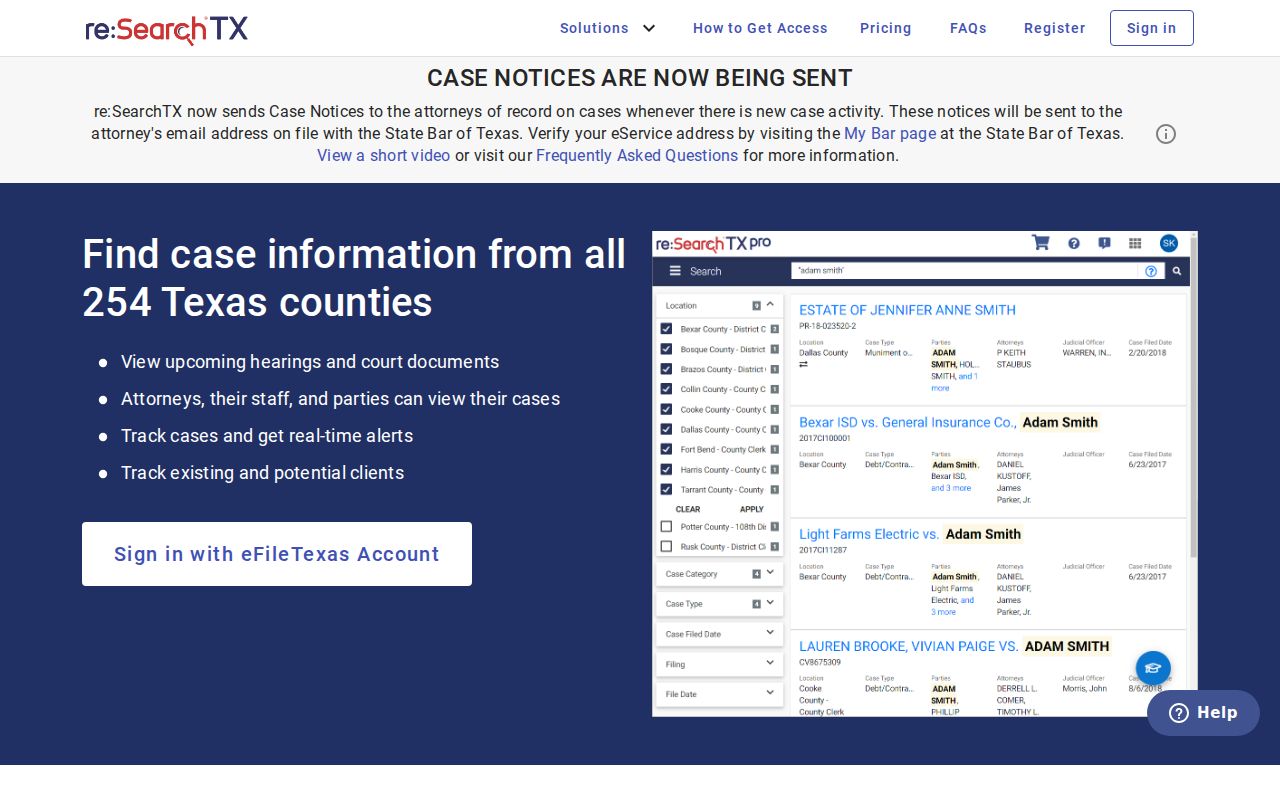
Use the portal as a document route, not as proof that no case exists when a search returns nothing.
Orange County Misdemeanor Searches
The County Clerk offers self-search tools, public computers, index books, and a staff search by mail. Staff searches cost $5 per defendant name and record type. They cannot be ordered by phone or email. Include as much as possible, such as the defendant name, offense, offense date, case number, style, or file year.
Plain copies cost $1 per page, and certification adds $5 per document. The County Clerk search-request page explains these separate options.
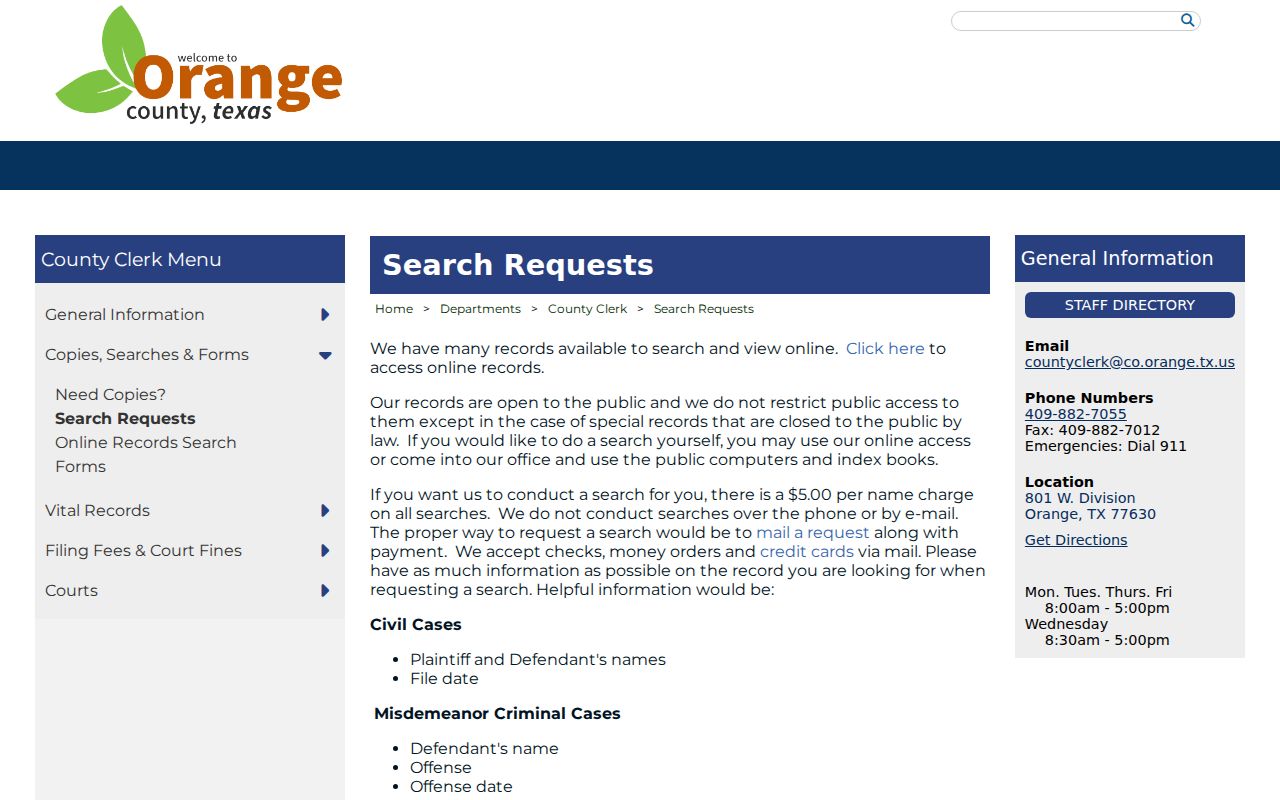
This mailed staff-search path is valuable when the online index fails or a reader cannot use the courthouse terminals.
Self-search and staff-search are not the same service. A visitor may inspect public computers and index books at the clerk's office. A mailed request asks staff to search a specific name and record type after payment arrives. Because the clerk will not perform that staff task by phone or email, a caller should use the phone to confirm current instructions rather than expect a completed name search.
Note: Orange County warns that its linked records system requires a computer and does not support phones or tablets.
What the Case File Shows
A criminal file records the court's version of the case. It can carry the charging instrument, docket events, orders, hearing entries, filed motions, plea, judgment, sentence, financial ledger, and appeal activity. Some documents may be redacted, restricted, or available only for a fee. The certified judgment is the clearest source for the final disposition.
| Case Number and Court | Identifies the file and the Orange County court responsible for it. |
|---|---|
| Charging Document | Shows the complaint, information, or indictment filed in court. |
| Docket Entries | Dates and brief labels for filings, settings, orders, and case activity. |
| Hearings and Documents | May show hearing entries, attorneys, motions, orders, and view or purchase controls. |
| Disposition and Judgment | Records dismissal, acquittal, deferred adjudication, conviction, or another outcome. |
| Sentence and Appeal | Shows the imposed sentence and any appeal to the Ninth Court of Appeals. |
Orange County Charge Destinations
Court level is a fast routing clue. District courts hear felonies. The county-level courts handle Class A and B misdemeanors. Justice and municipal courts keep fine-only matters. A warrant or capias also stays tied to its issuing court, so a district search cannot rule out a municipal or justice-court case.
| Charge level | Record custodian | Best first contact |
|---|---|---|
| Felony | District Clerk | Felony desk, 409-882-7817 |
| Class A or B misdemeanor | County Clerk | 409-882-7055 or mailed staff search |
| Fine-only or ordinance | Issuing municipal or justice court | The named court on the citation or docket |
The City of Orange Municipal Court is one local fine-only court channel.
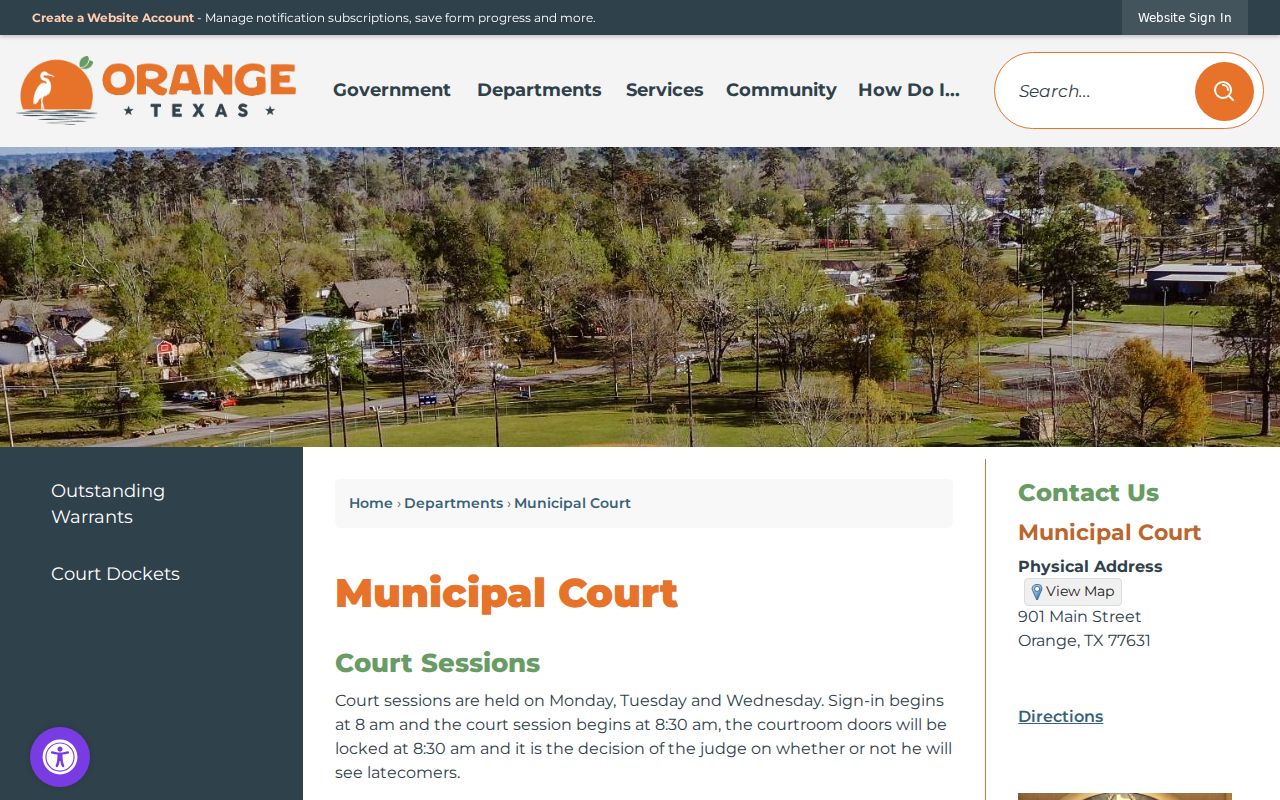
Its separate portal confirms why city citations should not be forced into the county felony search.
Stages of a Criminal Case
After arrest, a magistrate advises the accused of rights and considers bond. Texas law calls for prompt magistration, generally without needless delay and within 48 hours. The prosecutor then reviews the arrest facts. A felony may proceed by grand-jury indictment, while a misdemeanor often proceeds by information. Pretrial settings and motions follow arraignment. The matter ends through dismissal, plea, trial, judgment, and sentence, with an appeal possible afterward.
Case flow: Charges Filed → Arraignment → Pretrial → Plea or Trial → Disposition → Sentencing
The docket can lag behind the jail event because a booking record starts before the prosecutor files a court case. A reader tracing the full event should compare dates and charge labels across both systems.
Orange County Case Outcomes
Similar-looking status words have different effects. A dismissal ends the filed charge without a conviction, but it does not erase the related arrest. Deferred adjudication places a person on community supervision without entering a final conviction when completed as ordered, yet DPS may publish it in the public conviction product unless later relief applies. An acquittal is a not-guilty result and may support expunction, though removal still requires the legal process.
- Disposition
- The outcome or present status of a charge.
- No-bill
- A grand jury declined to return an indictment.
- True-bill
- A grand jury returned an indictment.
- Capias
- A court writ directing an arrest after a case event or judgment.
A court judgment can settle an ambiguity that the booking roster cannot. If DPS later shows the wrong outcome, obtain a certified Orange County disposition and use the DPS error-resolution process.
Access & Restrictions
Texas court access operates alongside confidentiality laws and judicial rules. The Texas Public Information Act does not make every court document public. Juvenile records, sealed and expunged matters, protected victim information, living-person birth dates, driver-license numbers, and other private identifiers may be withheld or redacted. A missing online file may also be old, archived, delayed, or outside that portal's participating courts.
Ask the clerk that holds the file about inspection and copy options. The District Clerk is at 801 W. Division Ave., Room 106, Orange, and can be reached at 409-882-7825. Its regular day includes a noon closure, and Wednesday starts at 8:30 a.m. The County Clerk is in the same courthouse and keeps different hours.
Government Code Chapter 552 gives the public a route to existing government information, but one office does not have to collect another custodian's record or answer legal questions. Judicial access rules separately shape court-file availability. When an online result lacks a document, ask whether the item is restricted, available only at the counter, archived, or subject to a copy charge before concluding it does not exist.
Access rule: Government Code Chapter 552, Chapter 411, judicial access rules, and court sealing orders can each affect what an Orange County criminal court search returns.
Orange County Felony Desk
The District Clerk's physical counter remains the authoritative fallback for felony case files. It can confirm the court, locate older pleadings, explain available copy formats, and certify a judgment. The office does not replace legal advice, but it can identify records already on file.
Orange County District Clerk
801 W. Division Ave., Room 106
Orange, TX 77630
409-882-7825
Felony desk: 409-882-7817
districtclerk@co.orange.tx.us
The District Clerk's official page is the source for its current office details.
Confirm current hours before travel, especially when a certified copy is needed the same day.